The $44 Trillion Question: What Anthropic's Internal GDP Model Actually Claims
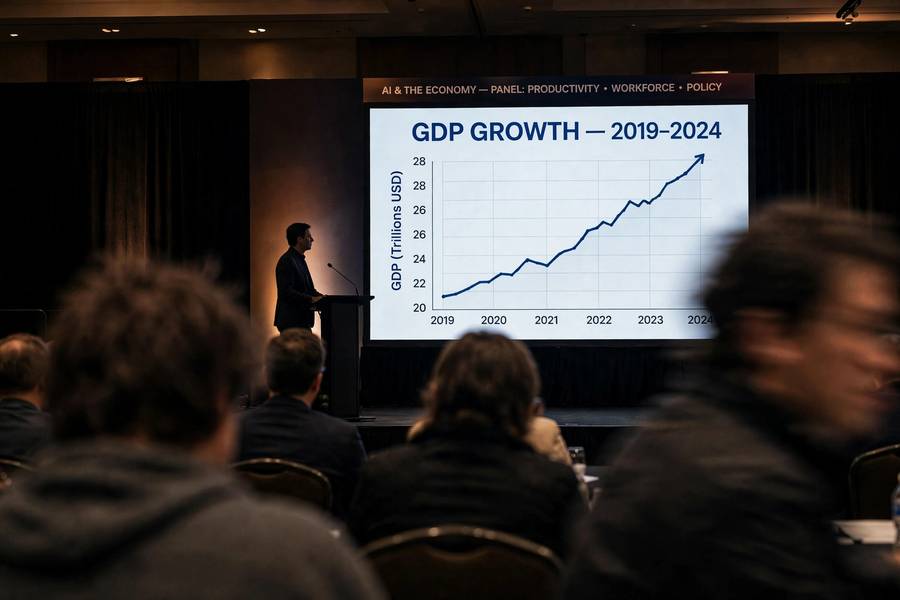
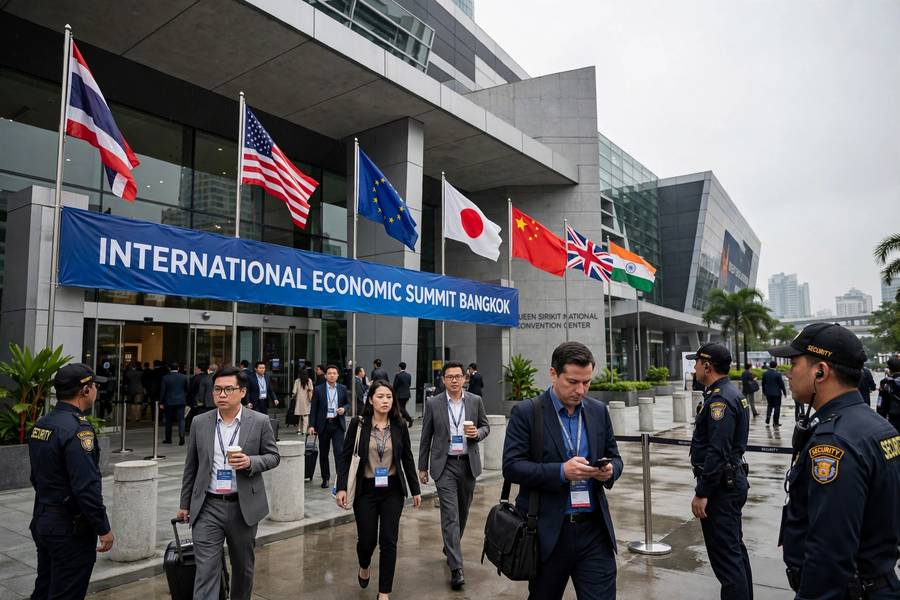
At the IMF and World Bank annual meetings in Bangkok, Anthropic co-founder Jack Clark dropped a number that sounds made up: one of the company’s internal economic models, he said, projects that AI could expand US economic output to $44 trillion by 2030 — up from just over $30 trillion today. He admitted it “sounds very outlandish,” then defended it anyway: the model is, in his words, “implicated by the technology continuing to get better.”
His framing deserves a close read, because the number is doing rhetorical work that the model itself may not support.
What the model would have to assume
A jump from ~$30T to $44T in four years implies sustained real growth of roughly 10% per year — three to four times America’s historical rate. Economic doctrine is unambiguous about what that requires: as Clark himself noted, entirely new industries and inventions would need to emerge to power it. Not efficiency gains in existing sectors — that buys a few percentage points — but the birth of new categories at the speed the internet produced its own economy, only faster.
The model’s core premise appears to be that AI is vastly increasing scientific discovery, which then compounds into economic output. That is a hypothesis about the rate of scientific progress, not a measurement of it. And it assumes frictionless conversion: discoveries become products, products find markets, markets scale, and none of it gets captured by the usual bottlenecks — regulation, infrastructure, talent distribution, or plain institutional inertia.
The venue matters
Clark didn’t say this at a product launch. He said it at the IMF and World Bank meetings, to the world’s finance ministers and central bankers, paired with a call for “unusual and serious rules” and international cooperation. That’s not an economic forecast — it’s a political argument dressed as one: if the upside is this large, the downside must be managed with proportional seriousness.
The framing serves Anthropic’s position neatly. A lab arguing for dramatic growth from AI is simultaneously arguing that AI must be governed “seriously” — and the entity doing both arguments gets to shape what “serious” means. Whether that’s sincere public-mindedness or regulatory positioning is a question worth keeping open.
Why you should be skeptical
Internal models from the labs building the technology have a built-in conflict of interest: the same companies selling AI infrastructure are the ones publishing projections that justify massive capital expenditure into that infrastructure. Clark’s admission that the figure sounds outlandish is honest; the less honest part is presenting a model’s output as a scenario worth governing around when its assumptions — frictionless invention, compounding discovery, zero absorption frictions — are the extraordinary part, not the conclusion.
There’s also the base-rate problem. Every major general-purpose technology — steam, electricity, the internet — produced growth forecasts that were both right in direction and wrong in timing by a decade or more. The claim here is far more aggressive than any of those: not a productivity wave over decades, but a 46% expansion of the world’s largest economy in four years.
The useful takeaway
Strip away the number and Clark’s argument has a real core: AI’s economic impact will hinge less on model capabilities than on what new industries actually get invented and how fast institutions can absorb them. That’s the right question, and it’s notably harder to answer than training a bigger model. The $44 trillion figure is a prompt, not a prediction — a way to force the question onto an agenda where, as one observer at the Bangkok meetings put it, policymakers feel “something really bad could happen” but have no roadmap.
Watch for whether the lab publishes the model. Until the assumptions are public, $44 trillion is a story Anthropic is telling itself — and telling the IMF.
Sources: Reuters (Oct 17, 2026); Reuters (Oct 18, 2026). The $44 trillion figure and quotes are from Jack Clark’s remarks as reported by Reuters; characterization of the model’s assumptions is the author’s analysis.