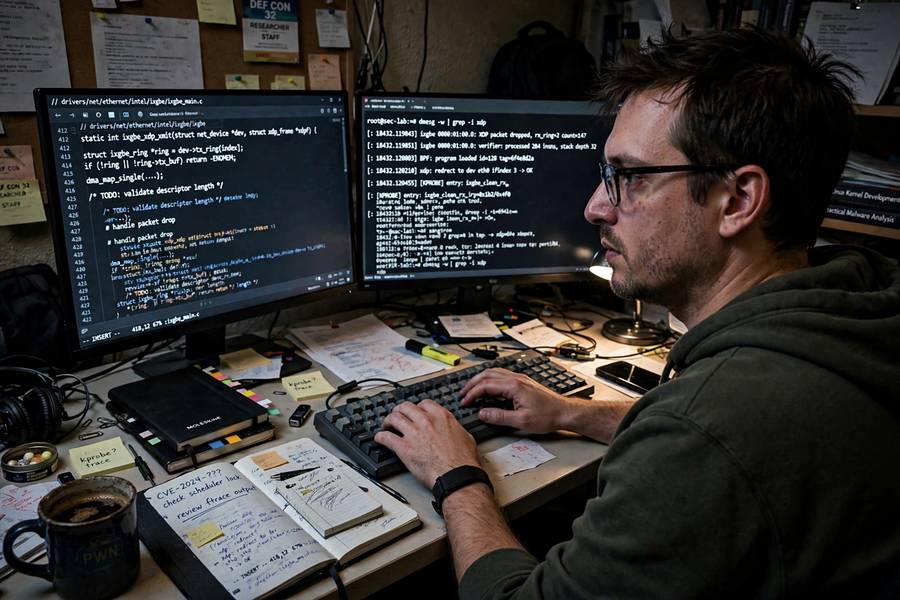
OpenAI's AI Found 948 Linux Kernel Flaws in One Run — and Wrote the Patches
Finding a bug in the Linux kernel used to be a career. On November 4, OpenAI reported that one automated pipeline did it 948 times in a single run — and wrote a candidate patch for each one.
In a research post titled A thousand fewer paths to root, OpenAI describes an autonomous vulnerability discovery, exploitation, and patching pipeline built around an upcoming cyber model. The run took place in mid-October, against a target OpenAI chose deliberately: the Linux kernel, more than 40 million lines of code, running under Android phones, cloud servers, and supercomputers alike. The pipeline’s “Scouts” picked 5,034 audit targets covering about 2.8 million lines — roughly 7% of the kernel — and went to work.
The funnel, in numbers
The headline figure is the end of a funnel, and the funnel is the point. The pipeline produced 2,308 candidate findings. Of those, 1,724 were dynamically reproduced in isolated virtual machines — running a stock desktop operating system with SMEP, SMAP, KASLR, and HARDENED_USERCOPY enabled, not a deliberately weakened target. The exploit stage then produced 291 information-leak proofs of concept and 1,169 working local privilege-escalation exploits. Variant analysis grouped those into 948 distinct issues, each with its own candidate patch.
The whole run cost $1,213,430 in API credits — about $1,279 per unique privilege escalation. OpenAI’s own comparison point is a late-July 2026 run using GPT-5.6 Sol, which found 166 unique local privilege escalations for $513,690. The new pipeline found nearly six times as many flaws at roughly two-and-a-half times the cost.
Every finding passed through human review before anything went to a maintainer. OpenAI says it has sent hundreds of critical reports and patches, with the remainder to be distributed gradually alongside its Patch the Planet partners. The work sits under Daybreak, the initiative OpenAI launched with Trail of Bits on June 22, 2026, pairing AI-assisted research with expert review while maintainers keep control over patch deployment and disclosure.
What 948 does — and does not — mean
Local privilege escalation is a specific, bounded kind of flaw: code already running with limited permissions on a machine gains root. It does not by itself give an outsider a way in. And 948 findings is not 948 fixes deployed. The candidate patches still need maintainer review and integration before they reach any machine running Linux, and the upstream tally lags the headline: a detailed secondary summary of the report put the count about ten days after the run at 61 patches merged upstream, with 43 more staged.
That gap is now the real story. The same week, the PHP2Shell flaws — memory-safety bugs in PHP’s core engine, disclosed with patches on October 21 — showed the same pattern from the other side: AI tooling turned a known out-of-memory bug into working code execution in about two weeks. Finding vulnerabilities is getting cheap. Fixing them, at the pace maintainers can review and ship, is not.
Why it still matters
The figures are vendor-reported and have not been independently reproduced — OpenAI says so in its own account, and no outside party has yet rerun the pipeline. But even taken at face value, the run changes the arithmetic of kernel security. A single automated campaign, aimed at 7% of the kernel, produced more privilege-escalation findings than most human audit programs produce in years, at a cost a well-funded lab can afford as a line item.
If that pace holds, the bottleneck in Linux security stops being discovery and becomes triage: maintainers deciding which of hundreds of machine-written patches to trust, in what order, while the same tooling is available to anyone who wants to find the next batch first. OpenAI’s answer is to keep humans in the loop and ship the patches gradually. The open question is whether the rest of the ecosystem — distributions, device makers, and every server running an old kernel — can absorb fixes at anything like the speed they can now be found.