Anthropic's Amended S-1: The $895 Billion Commitment That Repriced the IPO

Twelve days after Anthropic filed the most anticipated prospectus in tech history, it filed an amendment that changed the story. The original S-1, published October 26, was remarkable for what it left blank: no price range, no share count, no raise size — and no figure at all for the company’s total compute commitments. The amended filing, submitted November 2, filled in the blanks with third-quarter financials and one number that now defines the entire offering: $895.4 billion in purchase commitments and leases, roughly half of it due before the end of 2030.
The market’s reaction was immediate and expensive. Investors who had been discussing a valuation of about $2 trillion pulled it down to $1.5–$1.6 trillion, according to Reuters and the Wall Street Journal. That is a haircut of several hundred billion dollars in a week, applied to a company whose revenue is still growing more than tenfold year over year. Something in the amendment spooked the people who are supposed to buy it.
The quarter that slowed down
Start with the revenue, because it is genuinely extraordinary and genuinely the problem. Anthropic generated $16.96 billion in the three months ended September 30, 2026 — up 1,127% from the same quarter a year earlier, and up about 47% from the $11.56 billion it posted in the second quarter. For the nine months to September 30, revenue reached $33.24 billion, roughly twelve times the comparable period in 2025. Full-year revenue in 2025 was $4.6 billion. No company of this size has ever grown this fast.
But the trajectory is bending. Quarter-on-quarter growth was about 144% from Q1 to Q2, then 47% from Q2 to Q3. That is still a blistering pace by any normal standard — and it is the first concrete evidence that the explosive phase is moderating. Anthropic also disclosed that price reductions and contractual discounts shaved roughly $600 million off third-quarter revenue, a reminder that the price war with OpenAI, covered here in October, is being fought on the revenue line itself.
The bottom line needs the same care as the first filing’s. The reported net loss for Q3 was $23.29 billion, down from $66.3 billion in Q2. Almost all of it — about $21.9 billion — is a non-cash fair-value charge on convertible notes, derivatives, and SAFEs, driven by the rise in Anthropic’s own valuation. It is an accounting artifact of success, not a cash cost, and it will disappear once the instruments convert at IPO.
The number that actually matters is the operating line, and it moved the wrong way. Anthropic swung to a $567 million operating loss in Q3, reversing a $974 million operating profit in Q2. The driver: computing and infrastructure costs reached $10 billion in the quarter alone, rising from 48% of revenue in Q2 to 58% in Q3. Anthropic bought about $5 billion of compute under costlier short-term deals rather than cheaper multi-year contracts, and took roughly $2 billion of non-cash donation-matching charges. The company that looked operationally profitable in June is operationally unprofitable in September — because the cost of the intelligence it sells is rising faster than the price it can charge for it.
The $895 billion number
The commitment figure is the amendment’s real disclosure, and it is worth reading carefully. As of June 30, the original S-1 disclosed approximately $265.6 billion in compute commitments. Three months later, the total is $895.4 billion — more than tripled — with roughly $447.5 billion expected to be incurred before the end of 2030. Anthropic held $146.6 billion in total liquidity as of September 30, including cash, short-term investments, and an available credit line. The commitments are more than six times the cash on hand.
That gap is the bet, stated in the filing’s own arithmetic. Anthropic is promising to spend nearly a trillion dollars on compute over the coming years, and it can only fund that from future revenue, future debt, or future equity — including the more than $100 billion this IPO is reported to raise. The offering is not a victory lap on a profitable business. It is the financing round for the spending itself.
This is also where the IPO stops being a story about Anthropic and becomes a story about the whole AI boom. The commitment figure is the first time any frontier lab has put a public, audited number on what the race actually costs. OpenAI’s compute-campus deals, Google’s infrastructure buildout, and Meta’s datacenter spending all sit in the same order of magnitude — but they sit inside diversified balance sheets. Anthropic is a pure play. Its prospectus is the first clean look at the unit economics of a frontier model company, and the clean look says: revenue is doubling every few months, and compute still eats more than half of it.
What the valuation cut actually says
At the revised $1.5–$1.6 trillion range, Anthropic would trade at roughly 22 times its annualized third-quarter revenue. At the original $2 trillion, about 30 times. NYU finance professor Aswath Damodaran, working from the S-1, valued the equity at about $1.475 trillion — the low end of the range investors are now discussing. The cut, in other words, is not a collapse of confidence. It is the market moving from pricing Anthropic on the growth rate to pricing it on the margin structure — and the margin structure got worse in the amendment.
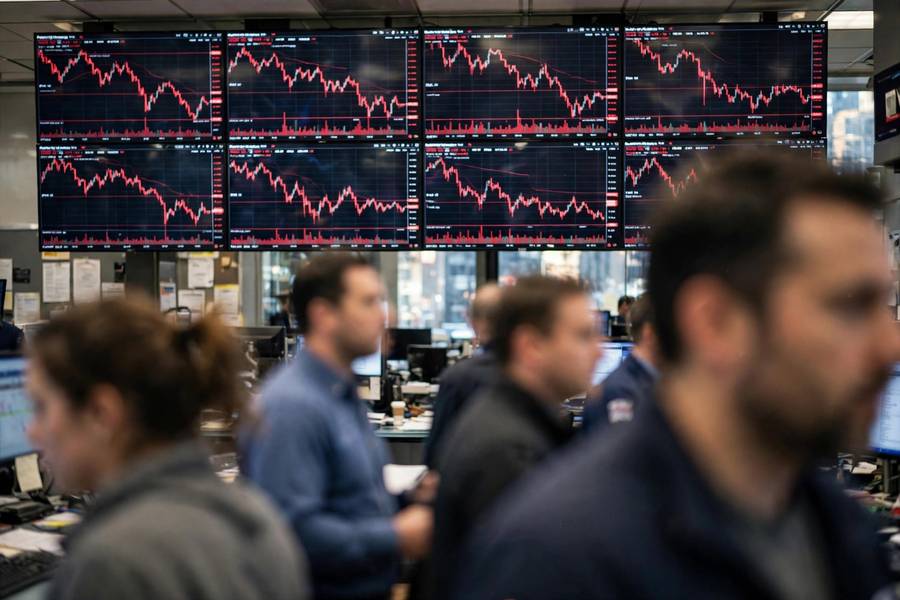
The timing makes the repricing sharper. The roadshow is expected to begin during the week of November 9, with trading possibly starting before Thanksgiving on November 26, according to Bloomberg’s reporting. That puts Anthropic’s bankers — a 22-bank syndicate led by Goldman Sachs and Morgan Stanley — on the road the week after the Nasdaq’s worst day since April, when the index fell 5.5% on November 5 as midterm politics hit the data-center boom. The company is going public into the exact market that just questioned whether the data-center boom is priced correctly, carrying a prospectus whose largest number is a promise to spend $895 billion on data centers.
There is a counter-argument, and it is not weak. Anthropic was valued at $965 billion in its May 2026 Series H round — the revised IPO range is still roughly 60% above that. Its enterprise base, disclosed in the original filing, counts more than 11,900 customers spending at least $100,000 a year each. The revenue growth, even decelerating, is without precedent at this scale. And the non-cash losses that dominate the headlines will convert away at listing. A buyer at $1.5 trillion is buying the fastest-growing large company in history at a discount to where it was priced a week ago.
But that is the question the roadshow has to answer: is the discount a bargain, or the first honest price? The original S-1 let investors dream about a company growing 14× a year with no compute number attached. The amended S-1 attached the number — $895.4 billion, $447.5 billion of it before 2031 — and the dream got $500 billion cheaper. The roadshow starting this week is where Anthropic has to persuade the market that the spending is an asset, not a liability. The prospectus makes the spending undeniable. It does not yet make it profitable.
Sources: Anthropic’s amended Form S-1 (filed November 2, 2026) as reported by Reuters; CNBC and The Wall Street Journal reporting on the revised $1.5–$1.6 trillion valuation range; Dealroom’s S-1 summary; Bloomberg’s reporting on the roadshow timeline; Aswath Damodaran’s valuation estimate. Figures are as reported from the filing; the IPO price, share count, and listing date have not been set.